Covid19-Passbook: your EU COVID certificate in Apple Wallet
A web app that turned EU Digital COVID Certificates into Apple Wallet passes, without sending personal data anywhere. 45,000+ passes, 28 languages, no ads, no tracking. Running from 2021 to 2026, now closed.

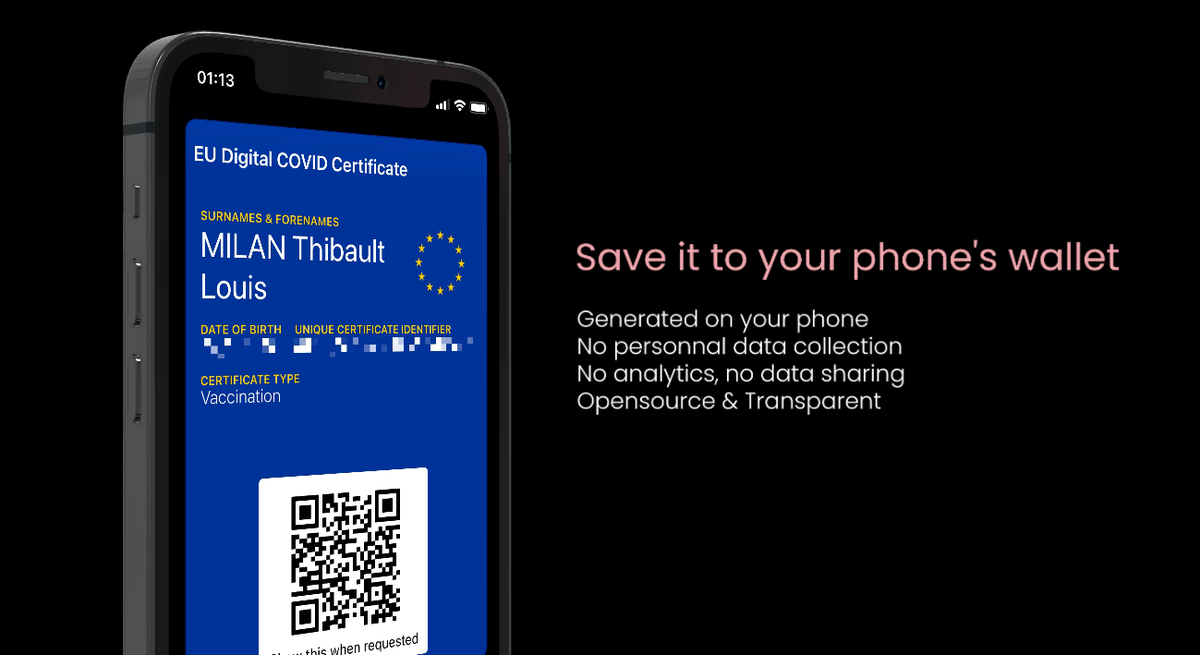
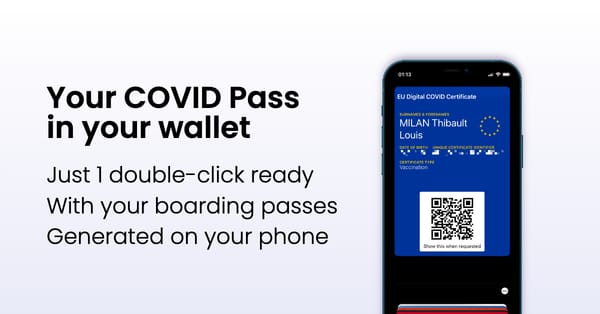
In June 2021, the EU started issuing digital COVID certificates. Mine came by mail, printed in grayscale, with a QR code and no app to keep it in. So I built a web page that turns that QR code into a card for Apple Wallet, without ever sending your personal data anywhere.
It ran from June 2021 to November 2026, generated more than 45,000 passes, and spoke 28 languages. It's now closed, and the site shows a farewell page.
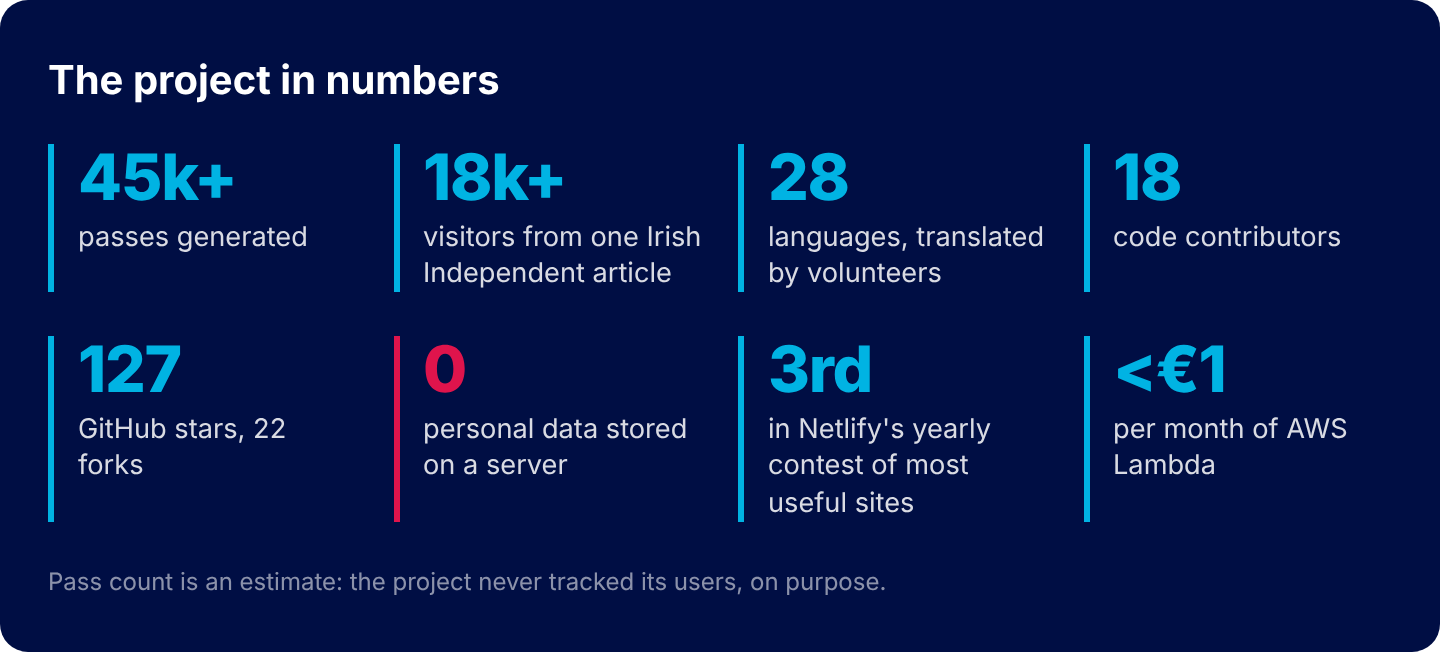
The project in numbers
- 45k+passes generated
- 18k+visitors from one Irish Independent article
- 28languages, translated by volunteers
- 18code contributors
- 127GitHub stars, 22 forks
- 0personal data stored on a server
- 3rdin Netlify's yearly contest of most useful sites
- <€1per month of AWS Lambda
Pass count is an estimate: the project never tracked its users, on purpose.
What it did
- Open the page in Safari, on your phone.
- Point your camera at the QR code of your EU certificate (vaccination, test or recovery), or import a screenshot.
- Check the preview of your information.
- Tap the button. The card lands in Wallet, next to your boarding passes. It also works on Apple Watch, and on Android with any app that reads
.pkpassfiles.
No install, no account, no store. A web page you use once and forget.
How it works
Apple requires every Wallet pass to be signed with a private key from an Apple developer account. That key can't be shipped to a browser. The usual answer is a server that receives your data, builds the pass and sends it back.
I didn't want anyone's health data on a server, not even for a second. So the work is split in a very uneven way:
- The phone does everything that touches personal data. It reads the QR code, decodes the certificate (base45, CBOR and COSE, using the EU value sets for vaccines and tests), builds the pass, and computes a
manifest.json: one SHA-1 hash per file. - The server only sees hashes. A small AWS Lambda receives the manifest, signs it in memory with the Pass Type ID certificate and returns the signature. No database, no stored content. It cost less than a euro a month.
- The phone finishes the job. It zips the files, the manifest and the signature into a
.pkpassand hands it to Wallet.
The site itself is a static PWA built with Parcel and served by Netlify. No cookies, no analytics, no trackers.
The rules I gave myself
Store as little as possible
The safest personal data is the data you never receive. Every architecture choice came from that one rule. It also made the privacy page short: there's nothing to declare.
I could have saved myself weeks by plugging into one of the many existing pass generators. They all work the same way: you send them the content, they send you a pass. Here, the content is the QR code, and the QR code holds everything in clear: full name, date of birth, vaccines, test results. Sending that to a third party wasn't an option.
Same reason there was never a Google Wallet button. Google Wallet passes are created on Google's servers, so every field of the certificate would have gone to Google. Android users got the .pkpass file instead, readable locally by apps like PassAndroid or Stocard.
Don't monetize it
No ads, no premium tier, no data to sell. A Buy Me a Coffee link paid for the Apple developer account, AWS and Netlify, with 10% going to LGBT non-profits. Every euro was in a public transparency report.
Where the coffees went
From the public transparency report. 60.5 coffees, every euro accounted for.
Be useful, then get out of the way
The goal was never to grow a product. It was to fix a small, annoying problem for as many people as possible, for as long as it existed. When Apple added EU certificates to Wallet in iOS 15.4, the project had done its job.
Open by default
The code is on GitHub. People could check what the app did instead of trusting what I said. That openness brought translators, contributors and, later, a white-label version for Doctoranytime, a health booking platform that offered it to its own patients.
Stack
- Front-end: HTML, JavaScript, Sass, Semantic UI, built with Parcel
- QR and certificate: nimiq qr-scanner, Path Check dcc-sdk, EU eHealth Network value sets
- Pass generation: JSZip, qrcode.js, Handlebars
- Signing: AWS Lambda and API Gateway, deployed with the Serverless Framework
- Hosting: Netlify (sponsored account), with a Netlify Function that turned in-app bug reports into GitHub issues
- Translations: Crowdin, 28 languages
- Testing: BrowserStack, on more iPhones than I'll ever own
The other COVID-19 projects
Covid19-Passbook was the last of a small series. Between 2020 and 2021, every new rule created a small, very concrete problem, and I kept building small, very concrete answers.
A small COVID-19 toolbox
Four answers to four problems, 2020 to 2021.
Which shops are open, which ones deliver. Crowdsourced, started in Dudelange.
Glide + Google SheetsQR codes on tables, menus on phones, orders without touching paper.
for small businessesContact tracing for venues, built live on Twitch in about an hour, given away for free.
#nocode ThursdayYour EU certificate in Apple Wallet. Personal data never leaves the phone.
45k+ passes- COVID-19 Venue Map (March 2020). During the first lockdown, nobody knew which shops were open. I built a crowdsourced map with Glide and a Google Sheet: open places, restrictions, delivery-only restaurants. People could add a shop or report an error. Read the original post.
- Digital menu and ordering (2020). QR codes on tables, menus on phones, orders without paper, for small businesses trying to stay open. Gathered on covidluxembourg.app.
- Customer Registry (March 2021). Some countries required venues to keep a register of customers. Paper sheets on a counter are a terrible idea during a pandemic. I built a QR code contact tracing form live during a #nocode Thursday stream, designed to delete the data automatically after 21 days, then gave it away for free.
Same pattern every time: a real problem, the simplest tool that works, as little data as possible, and no business model.
Credits
This was never a one-person project.
- Alain Vagner built the signing service with me.
- Guillaume Rischard and Alain Rouen gave advice when it mattered.
- Laurence Vagner redesigned it, Geoffrey Crofte made it accessible.
- 18 code contributors on GitHub, and the volunteers who translated it on Crowdin.
- Baptiste Lilles at Doctoranytime, for the white-label.
- Netlify and BrowserStack, for the free accounts.
- The press: the Irish Independent, Silicon Luxembourg, data.public.lu and others. The full press review is on the farewell page.
The fine print
The project is closed. The site shows a farewell page, the AWS stack is deleted, and the GitHub repositories are archived. Passes already in people's Wallets were never stored on any server and are not affected.
The code stays public on GitHub: the generator and the signing service.
For the full story, what worked and what didn't, read the post-mortem: https://thibaultmilan.com/covid19-passbook-post-mortem/
Covid19-Passbook
The farewell page: the story, the numbers, the press review and the thank-yous.