I sold my VR headset. Meta kept my living room.
Part 1 of a series built on my own Meta data exports. The headset measured every object in my living room, gave each one an ID, and kept the logs of my hands.

I sold my Quest 2 last month. It was four years old and had mostly been gathering dust since summer 2025 (the classic VR arc: one very intense first summer, then the shelf). Factory reset, lenses wiped, back in the box, buyer, done.
Before it left, I did the thing data people do. I asked Meta for everything it had on me.
That's actually two requests. The standard export arrives the same day, as HTML or JSON. The "data logs" take about two weeks and come as a separate package. Mine weighed about 7 GB. (I'll come back to that number. It's not the headset's fault.)
There's a lot in there, so this is going to be a short series. This first episode is about the headset. The next ones cover the Ray-Ban Meta glasses, then Meta AI.
My living room has a Meta ID
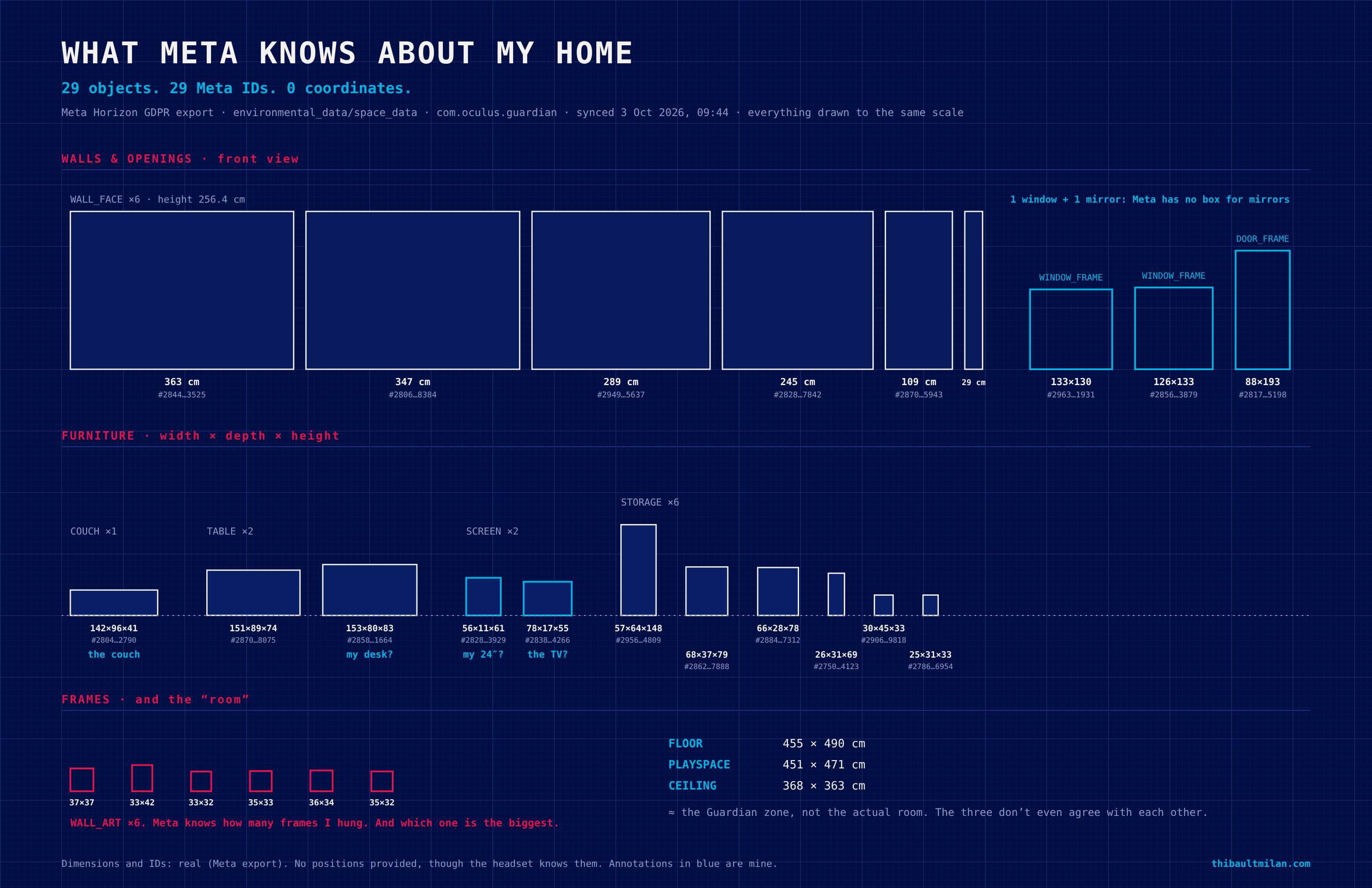
The file that made me stop scrolling is called space_data. It lists 29 objects:
- 6 walls, all 256.4 cm high
- 6 frames hanging on those walls
- 6 pieces of storage
- 2 windows, 2 tables, 2 screens
- 1 couch, 1 door, a floor, a ceiling, and the play area
Every one of them is measured to the millimetre. My couch is 141.8 × 96.3 × 41.3 cm. The biggest frame is 32.9 × 42.5 cm. Meta knows how many frames I hung, and which one is the biggest.
Every object from my Meta space data, drawn to scale
On a Quest 2, nothing scans the room for you. You trace the walls with a controller, then draw boxes around your furniture and pick a label for each one. So technically, I did this data entry myself. For free. In my own living room.
(Well, mostly my living room. The space is labelled "Bureau", French for office, and it mixes both rooms: the couch from one, my desk and 24-inch monitor from the other. One of the two "windows" is actually a mirror. Meta's list of labels has no box for mirrors, so it went in as a window.)
Two details turned this from a list into something else.
First, every single object has its own Meta identifier, the same kind of long numeric ID a Facebook post gets. My couch has an ID. Each frame has one. You don't hand out IDs like that to data that only lives on a headset. These are records on Meta's side, synced on 3 October at 09:44, while I was getting the thing ready to sell.
Second, there are no positions. The file contains 87 numbers and every one of them is a dimension. No x, no y, no orientation. The headset obviously knows where the couch is, otherwise mixed reality wouldn't work. The export just doesn't say. Either positions never leave the device, or they do and they're not part of what I get back. I can't tell from here, and it's going on my list of questions for Meta's DPO.
The neighbours' Wi-Fi, too
Another table logs Wi-Fi: 116 readings from 23 different networks, each with a hashed identifier, a signal strength and a frequency, captured in a handful of scans lasting a few minutes.
23 networks is my building and half the street. A list of nearby access points with their signal strength is a Wi-Fi fingerprint, which is the standard way to locate a device indoors without GPS. That log goes back to May 2025.
Then there's the location history: four approximate positions in Luxembourg, rounded to roughly 100 metres, each with the "number of unique weeks" I was seen there. My purchases are logged with the IP address and the region they came from. And a "presumed country of origin" field says Luxembourg. Correct, for once.
227 emails, 131 of them to check I exist
Meta sent 227 emails to the account's address. 131 of them are typed oc_push_reachability_check. As far as I can tell, their whole job is to confirm the address still answers. Another 32 are promos.
One day of logs (but what a day)
Back to that 7 GB logs package. The part about the headset weighs about 16 MB, and it covers exactly one day: 26 September 2026, the session where I reset everything before the sale.
My first reaction was "they wiped it". Looking across the tables, it looks more like rolling retention. Each table keeps its own window, and technical telemetry expires fast. My previous real session was in July 2025, long gone. Keep that in mind for part 2, because some tables are kept much, much longer.
Still, one afternoon is enough to learn a lot.
My hands, in 3D. 376 interactions with the system menus, each logged with the [x, y, z] position the gesture started from. It's the only spatial data in the whole export. Meta won't tell me where my furniture is, but it will tell me where my hands were.
My face, sort of. Lens spacing set to 63 mm, which follows the distance between your eyes. Dominant hand: right. And a profile flag that reads "Not tween".
An age check on an adult account. The parental supervision table holds 120 events, mostly screen-time data "processed" and "received by the server". Plus an age verification attempt that concludes, and I quote: "Cannot determine if the person should verify their age". Same, Meta. Same.
Permissions, in bulk. 284 permission changes during the reset, mostly revocations. A few grants stand out. A Meta system app with an automation-sounding name gets precise location, including in the background. The media player gets "Track eye movement" on a headset that has no eye-tracking hardware. The Quest Pro does have it. So the permission is already there, waiting for the hardware to catch up. A permission isn't proof of anything. It's still a strange line to read.
Two lives. In the same session, the account flips between "Personal device" and "Quest for Business".
And what's missing: my desk setup. I had a stationary zone in the bedroom, with the desk and screen measured and my Logitech MX Keys tracked in passthrough, so I could type on as many virtual Mac screens as I wanted. I searched every file for keyboard, Logitech, passthrough, Guardian, anchor. Nothing at all.
The headset was the small one
Here's the part I didn't see coming. Out of those 7 GB of logs, the headset accounts for about 0.2%. The rest comes from the 🕶️ Ray-Ban Meta glasses: three years of them, and close to two million lines.
That's part 2.
Where you live
For years, the privacy conversation was about what you click. Headsets and glasses quietly move it to where you live: the size of your walls, the networks around you, the way your hands move through the air.
None of this was hidden. It's all in the setup wizard, the settings, the terms. I clicked through every screen myself, and I drew those boxes around my own couch.
The headset now lives with someone else. Its idea of my living room is still on a server somewhere, 29 IDs and all.
Next: the Ray-Ban Meta glasses. Then Meta AI. The last episode will be a practical one: how to get your own data out, and what to ask once you have it.